Due to our audience being a small niche of horror watchers who are also tech-savvy, we consider them a a hard to reach audience who rarely watch television. However, from research we have founs that they do spend a lot of time on social networking sites.
Therefore, to achieve a karge audience at our official first screening, we set up a Faceboo events page and invited members.
Many said they were attending on the event and the turnout was great.
This and other viral campaigns is the best the way to contact our audience and reach out to them to inform them of our film. They will also want to be able to invite friends and send information to eachother via the net. so a net based marketing campaign is the way forward. Other places we have seen campaigns like this is with the launch of paranormal activity with the demand it scheme which created huge media attention.
After intense research, into the thriller genre and it's main audience. We were able to structure our sequence around the audience to create the greatest appeal to them. There are parts of the film which, for our audience, will create both pleasure and pain.
I think the film addresses the audience well with the thrill it provides and the sexuality portrayed in the film.
During our research and planning stages, we created a character profile explaining who our main target audience is. From knowing our target audience we were able to create a character profile. This profile compiled all the information we had found out from research. Fortunately the media technician in school fits into our target audience.
Here is a moodboard of our target market's interests.
There are two main companies behind the production and distribution of my product.
One is the production company; Green Tree Productions.
Green Tree Productions is a small London based production company who help/specialize in low budget films made by un-known directors. Their clients are usually local (to London) and many films do not make it onto the big screen. However a few have been exhibited at specialist film festivals and become internet sensations. They produce a wide genre of low budget films.
Tough monkey films are a similar company to Green Tree. They are looking for the next generation of talent.
They have both their own productions and also help to raise finance for independent directors.
The distribution company, the other main institution, works in synergy with Green Tree Films and distributes the majority of their horror films.
Even though Green Tree Productions are not a specialist horror producer. They will always look to DBB Films, who are specialist horror distributors, to distribute their films of the horror genre. The relationship between these two institutions is similar to the one we see with Icon and Paramount Pictures. Paramount Pictures, a production company, produce their films for American audiences. However, they also want to distribute films to the UK and Australia. Icon and Paramount also work in synergy to create an easier path to distribution.
As this film is only a low budget production. It is unlikely that it will make it to the big screen apart from screenings at independent local cinemas, such as; The Phoenix in North Finchley and The Rio in Dalston.
It is more likely that it is put on a DVD platform or maybe onto a website for pay per view download/streaming material. However, if the film were to go global, following in the footsteps of paranormal activity, the film could be distributed through more expensive platforms, such as theatre viewings and BLU-RAY DVD.
I could see the release of this film being something similar to that of paranormal activity. It could easily build up a cult reputation through internet viewings and then suddenly, a few years after its initial release, it hits the big time and becomes one of the most gripping, tense, and scary films anyone has ever seen.
My opening sequence only has two characters. The different social groups represented are gender and mental condition.
The two gender opposites are the main female character and her male binary opposite.
The relationship between the two fits with the stereotypical representation of a female character with the male being the more dominant of the two. We have also see dominance like this in other films including cellular with Jason Statham and Kim Basinger.
This dominance is highlighted by the clear power difference between them. On one hand you have the female locked in a shed, clearly overpowered by the main male we see. Who, is wandering round his house completing his daily routine. This clearly shows the separation between the two, with him being highlighted as a more powerful being.
The mental state of a character is also strongly represented in my piece. The main male figure is a sufferer from Obsessive Compulsive Disorder. He is seen completing an otherwise normal daily routine with sets of four. He does things four times over. His mental state is clearly presented as volatile and un-stable. We got the idea to run a OCD character from a video on youtube.
The stereotype for mental health is usually basic, but can sometimes go deeper showing extreme signs of psychosis. A prime example of this is from Silence Of The Lambs. In which we see a male character that is an OCD sufferer capture a girl and almost look after her. Which our character sticks very close to. This shows that mental instability can be shown in any form.
The coursework brief I was assigned was to make a film opening sequence. The chosen genre for my opening sequence is thriller.
There are many theories behind how films should, and do, work.
Certain genres have certain enigma codes paired to them. Thrillers are usually depicted in films by contrast of lighting and concealing information.
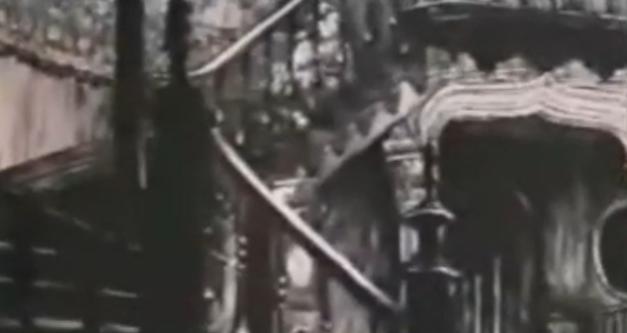
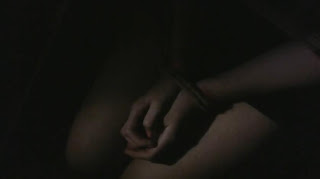
The image shown here is of the protagonists feet in the second scene of the sequence. However, from the image we cannot determine whether it is male or female. The light cleverly creates a good contrast on the object in focus which makes the audience gradually piece together what is happening in the narrative. The lighting and concealing of information is an obvious enigma code of the thriller genre. As we see here in a still from the The Others.
The director has used light really well to allow us to see the figure sitting at the top of the stairs, however the shot is vague enough so that information is concealed and we are therefore left piecing the rest of the story together.
Another horror/thriller signifier is blood and general violence.
Although it is hard to make out there is blood clearly visible on the wall of the shed. This example of violence is a strong enigma code of the thriller genre. Other films we see this in include the Saw series and Hannibal.
The use of blood here allows us to clearly see that the film is a horror/thriller based film.
Tzvetan Todorov suggested that all films, and especially opening sequences, start with a base of equilibrium in society. He suggested that this equilibrium is then broken and it is the protagonist's job to restore order. This is called the disruption.
My opening sequence starts with the equilibrium of someone's daily routine.
The equilibrium is then broken as we are introduced to the protagonist. It is clear that this girl being locked up is no ordinary occurrence we can then assume that this is the disruption that the protagonist has to conquer.
These two images also highlight two of the binary opposites in our sequence.
Obviously you have the binary opposite of male and female characters and clear representation of good and evil.
However, it goes deeper, you have the opposites of comfort and dis-comfort between the two characters with the kitchen being a well modelled living space compared with the dingy area that is a shed. From watching the entire sequence we can assume who the villain is, however it is only late in the sequence when we find this out. The man seen in the start of the sequence is only recognisable as the villain when we seen what he has done, or what we assume he has done.
Not only does this shot lead us to the disruption in the sequence, but it is also when we first see the man as a villain.
The shot clearly goes back through his house and into the shed at the end of the garden.
We, as an audience, are then introduced to this. Although we know very little information about the person, we can see that they are tied up and obviously a victim or hostage. The fact it is in his back garden makes us assume that he put her there and can guess at him being the villain. There is no clear evidence that the kidnapped female is the protagonist from the opening sequence, we may be able to guess as she is introduced early on, but the fact she is a victim maybe suggests she isn't. On the other hand, the film Quantum Of Solace, released in 2009. Shows Daniel Craig escaping after being captured. He is clearly the protagonist later in the film, but has to resolve an initial disruption before anything can happen.
The form my opening sequence takes is one with a series of title screens that evenly break up a montage of clips. The titles work well to break up the lengthy and at points quite boring narrative behind making a cup of tea. They keep the audience interested for longer until we see the more exciting and fast paced 'action' in the sequence.
My opening sequence conforms well to conventions behind opening sequences. We are eventually introduced to two main characters who are in-fact the protagonist and the villain.
However, the location shot in the opening sequence is not one that will appear a lot in the full film but will appear for short pivotal scenes. Although we can still scope how the rest of the film will pan out.
What forms can opening sequences take? Can you list the conventional features of opening sequences?
There are a number of ways of presenting opening sequences:
- Opening credits overlayed onto picture. - Opening credits break up the montage of picture. - Straight into picture (first scene) followed by opening credits.
Conventional features:
- Introduce the main character of the story. - Introduce the setting; the main area/location which the film will centre around. - Contain referential codes; credits notifying audience of the production company, actors etc. This would give the audience an idea of what kind of film to expect, as certain actors and directors are well known for particular styles. - Opening sequences are use like introductions to the film and its storyline, so the audience gets a stong idea of what the film is going to be about.
What narrative functions of opening sequences can you identify?
-There is always some form of equilibrium at the very start -The protagonist is always introduced -There is an obstruction which the protagonist must resolve -It never has any closure as it is just to set the scene, leading on to the main part of the film.
What do audiences gain from watching the opening sequence?
- Audiences immediately will gain an understanding (hopefully) of what themes the film will be based around. - The Audience is also introduced to the main charcters, time and setting of the film. - The audience should be able to identify the genre clearly. - Clarity, interest and mystery should ultimately determine whether or not the audience wants to watch the rest of the film.
What do film-makers gain from including an opening sequence?
By having an opening sequence, film makers draw in the audiences attention. They do so by establishing genre, characters and style. An opening sequence provides the introduction to the plot which if successful, should set up a mystery to make the audience want to watch the rest of the film.
There are many pairs of binary opposites to be seen in the opening of 'Die Hard' and 'Pale Rider'... - Happy vs. Sad - New York vs. LA - Together vs. Apart - Contrast in musical themes - Good vs. Evil - Life vs. death - Prepared vs. unaware - Novice vs. Experience - Differences in approach, e.g. Bruce Willis walks into hotel and asks for direction, whereas bad guys enter and kill everyone along the way.
'Pale Rider':
- Cuts between Good guys vs. bad guys. - Contrast between soft guitar playing and loud horses running. - Everyday experience vs. spiritual experience. - Riders vs. Man alone. - Anger and fear vs. Calm. - Water vs. Flame. - Rich vs. Poor. - Survival vs. Death.
Applying Barthes Theory to the opening of SPEED:
Action Codes: The opening of SPEED is very clear in showing the audience the main characters, when we see the villian kill the guard it is immediately clear that he has evil plans. Once the police teams are called in we are introduced to the skyscraper where the situation is taking place and straight afterwards to our main characters with the police who will ultimately saved the day. We can tell that the film is set in the present day.
Semantic Codes: The character of Keanu Reeves clearly represents bravery and does all he can to save the hostages. His viewpoint; "shoot the hostage", which he mentions to his partner also determines his actions when his partner is taken hostage, as he shoots him in the leg.
Enigma Code: The situation in the building with the lift set to explode is discovered by the two main charcters and they do not hesitate to proceed in adverting the potential disaster. Mystery is set up as we are curious to find out more about the villain involved in these actions of terror and why he is doing it.
Referential Code: Information is revealed most obviously through the opening credits which seem to go on for an age! The mise-en-scene makes use of lighting contrasts e.g. it is bright on the ground floor of the building, the police staging area, but as they enter unknown territory it appears darker. The lift which is where the hostages are is almost pitch black as the power has been cut.
Symbolic Code: There are many symbolic codes in the opening sequence of SPEED, e.g. police uniforms symbolising authority and crime stopping. There is also symbolism in the characters emotions such as bravery and fear.
Hi, I'm Spencer Wilkinson and this is my AS Year12 Media Studies Blog. If you need to find any work associated with my coursework project you should be able to find it on here. Feel free to look around and watch my videos. Hope you enjoy the final project [when it gets finished].
xx
My Top 5 Favourite Films
Here is a list of my top five favourite films of all time:
1. Vertical Limit 2. Fight Club 3. Shaun of the Dead 4. Black Christmas 5. Who Framed Roger Rabbit